Saturday, February 26, 2011

Working Man

Sorry about the great length of time it has been since posting. There was not a lot of things going on to report about for a time then everything started moving all at once. Since the end of January, I have been elected to the Township Trustees (we most oversee several thousand dollars in tax revenue and use it in the maintenance of the public cemeteries (there is basically one) and the community park in the Elk Creek Township), I am now church council president (I did not seek this office, especially since we have to deal with issues with our pastors call), and lastly I started work with the federal government on a part-time temporary basis. I am working three days a week for the Natural Resource Conservation Service (NRCS) as a Soil Conservationist. Admittedly, I have not done much more then push paper as things have been so busy in the office that it has been hard to get trained. As I get trained, I will be dealing with an alphabet soup of programs that deal with farm conservation.

Back at the farm, we have had a few more lambs and lost one so we are at 18 lambs out in the building. The vast majority of the lambs are male so that bodes well for sales in the fall. We had about a week here where all the snow melted off and I let the chickens run outside during the day. One of those days cracked 50 degrees and Hazel and I sat on the front step outside and watched the birds in the front yard.

Several chickens are out for a late winter run

I made a decision to get rid of our three turkeys (the big Tom and his two ladies). They were not producing fertile eggs and we not performing guard duty to younger birds like they did in 2009, so I decided it was past time to see them re-homed. They have gone to a quail farm outside of Grinnell.

Turkeys just before we loaded them to leave

Other then this, a little more tree work has been done in the timber behind the house. I think about three to four more days of cutting and that project will be done for the winter. At the rate we are going at it, this will take about 4 weeks to finish. At that point, the ground should be workable again and I can start building sheep and cattle handling facilities. I got the tractor running yesterday and moved six bales from the neighbors place over to mine. That should feed the cattle and sheep for the next two weeks. Up the road from us, there are some old hog buildings being dozed and I talked with the landowner and he is letting me take the metal roof off a building. Jim and I got half the roof off in a day before the snow returned and made that task much harder to do.

Hazel drawn to the colorful night light

Needless to say, we have been keeping pretty busy. Hazel is doing well and adapting to being at the babysitter more. Based on her measurements at her most recent doctors check-up, she is still a tall and skinny child compared to her peers. She is a blast to be around and she is making new sounds every week in her efforts to communicate with us. Stay tuned her for updates as we approach the production season.

Monday, January 31, 2011

Winter Sheep Lessons

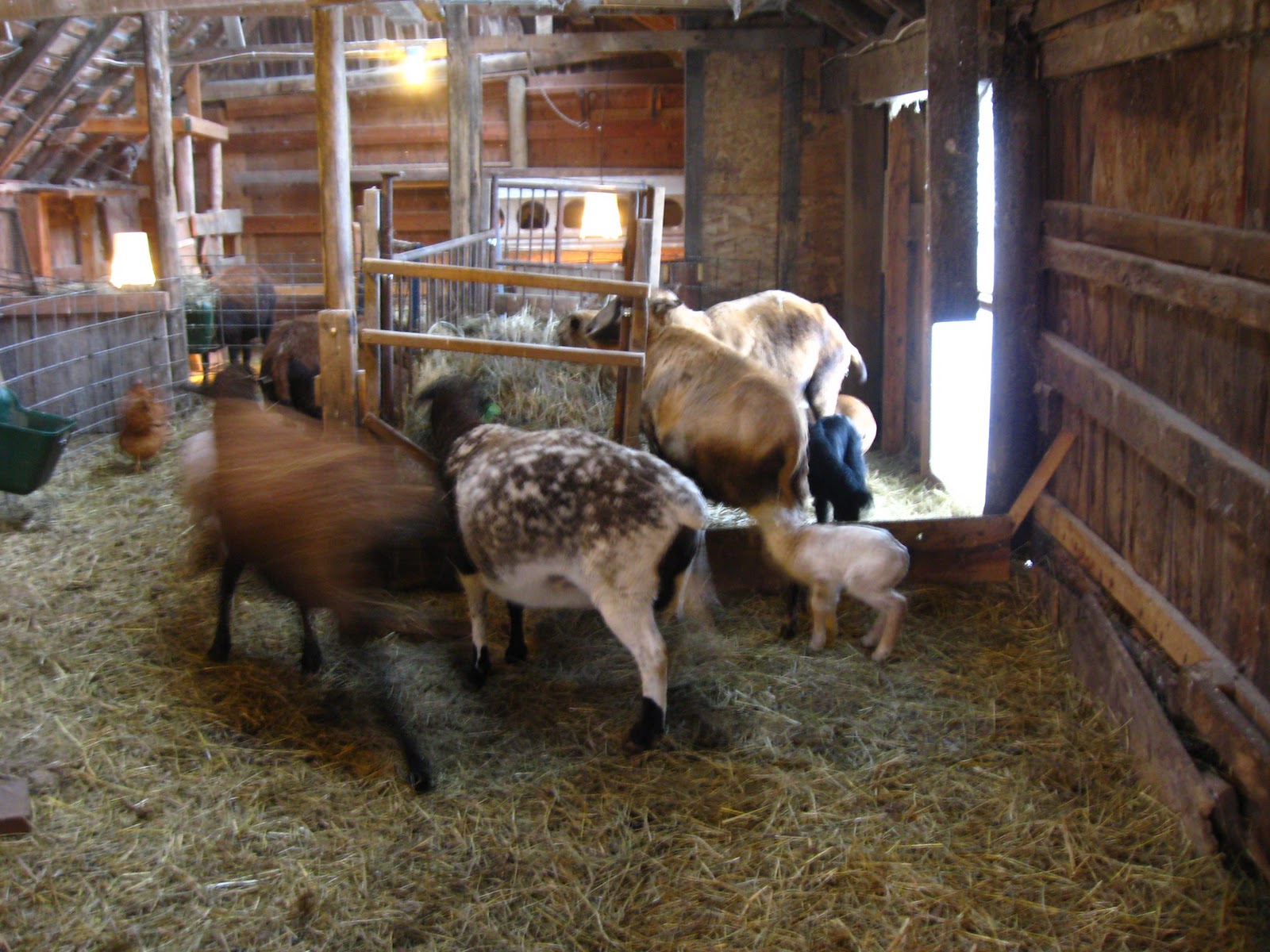
Well we are winding up lambing around here (14 lambs in the building and 2 in the house) and what can I say, I learned a few lessons. Lesson one: the ram does not get left with the herd for an extended period of time. Hence a long and intermittent lambing season. Lesson two: most of the Barbados ewes we purchased in the spring do not hold their body condition on hay alone, so they will be leaving. I will liquidate them in mid-June, when those that lost their lambs have had a chance to be rebred and they all have had pasture to raise up their body condition. Lesson three: lambing is likely best done (if done in winter) in March, not December and January. Lesson four: I have a better handle on how to take care of bottle lambs (feeding in the house for a week) and how to attach an orphan lamb to a ewe (headlock the ewe).

Lesson three, Janice and Hazel look after bottle lambs

This winter has highlighted several deficiencies around here. One being the lack of handling facilities and winter sheep lots. We had lots of trouble keeping sheep on our farm before we took electric net and layered it up against our high tensile exterior fence. The other problem we have been having is that the calves are not intimidated by the net in the winter. Frozen ground is not as good an electrical ground, so cattle on frozen ground do not receive much of a shock from the electric net. Hence the calves have been stepping over it and getting into the hay storage and the sheep area. 

I spy with my little eye: calves in the sheep shelter... darn you calves

In other news, we have continued to clear trees (you can catch a glimpse of it in the upper left corner of the above picture). We were selected to be part of the Practical Farmers of Iowa (PFI) Savings Incentive Program  (SIP) and so I have opened the special savings account to begin saving for this program. These funds will likely get put toward a larger sheep hoop building that can house the sheep in the winter and finish out feeder pigs while the sheep are out at pasture. Janice, Hazel, and I went to the Practical Farmers of Iowa Beginning Farmer Workshop this past weekend to work on our farm business plan, which is a requirement for SIP. We will be going to the Premier One Winter Sheep Day next weekend to look at their handling facilities and to examine their building layouts. To conclude this month on a somewhat humorous note: 
Do you see something wrong in this picture?

No? How about now?

Our young ram Aegis had his head stuck again in the hay feeder. This morning was the third day in a row he got stuck. The first time I just cut out a tine (I was running late to a meeting), the second time I cut out as many tines as I could before the cutting wheel died, and the third time I cut out the last of the times.  Now, every other tine has been removed from the old hog crate to make it easier for the the sheep to get to the hay and harder for the ram to get his head stuck. 

Friday, January 21, 2011

Just Cold

Today is the coldest day of this winter so far. It was -8 F or -22 C when I went out to chore this morning. When temperatures are that low, we take certain precautions. I wear a heavy face mask. I forgot to remove my glasses before going out. With the face mask, you build up some condensation from your breath on them and then it freezes. When I am not using my fingers, they are balled up into fists in my heavy gloves. You actually try not to wear too many layers because when you do move, you sweat and then when you stop moving, it gets cold.

Thermometer reads -8 F

Managing the livestock when it is that cold takes a few extra bits of attentions. First, the cattle take their hay down in the cover of the timber. I drag it down there on tarps and dump it for them to eat. I was impressed that our Cobett cattle water had less then a half an inch of ice buildup on top. That is thin enough that the cattle can break through it, but I usually open it up for them. I also collect eggs twice per day to limit the number of eggs that will freeze and crack in the building.

Cattle eating hay in the cover of the timber

Cattle Cobett water 

We have been lambing for several weeks now. I am down to two ewes left to lamb. As the ewes have been lambing, I have been moving them inside. The last two ewes to lamb are inside right now. We currently have 11 lambs with their mothers inside. We have some lambing trouble with with our Barbados ewes. They have not maintained their body condition on winter hay like our Katahdin sheep and we have lost a few more lambing.

 Ewes with lambs at feeding time

 One nice thing about winter is it is time to think about the next year and do some planning. Janice and I have a beginning farmer planning workshop coming up, we have been reassessing our production levels, and trying to plan farm expansion and look for some efficiencies. We recently did some visioning exercises and my wife has placed mine in a place of "honor." She blogged about it. It is nice to think about the future and try to work out the many kinks in our little farm. Other then this planning, I have done some tree work with Jim, but for the most part, I have been inside with Hazel taking care of her and enjoying her company.

Hazel playing in her room

I will start working for the federal government at the Natural Resource Conservation Service (NRCS) office in Newton part time. My skill sets are perfect for this work and are just not going to fit better anywhere that close to home. We used student loans to come up with the down payment on our land and this job represents a way out of that debt with in in two to two-and-a-half years. It will mean less time to farm so we are paying considerable attention to efficiencies on the farm and we will be thinning down our sheep herd to our best animals this year. I do not know if other changes will emerge, but for the time, these are the only changes we have currently planned. I will keep you posted on any changes that come up.

Friday, December 31, 2010

A Warm End to 2010

We have had three days of December thaw to close 2010. Along with 2010 has gone our 8 inches of snow with just a trace left in the shadows and where it drifted a bit.

A view of the south pasture (looking west) from atop the hay bales

Janice and Hazel have spent some time off the farm around the holidays. This has left me to my own devices for 11 days to do things about the farm. Admittedly, I was not all that productive, but I did mange to clean out my chicken building and brooders, just in time to start lambing. Two ewes lambed, but one ewe did not survive. I brought her lamb into the house for the first night and then drafted the lamb onto the first ewe that lambed. I had never done this before, but I had read about it a few times. I built a headlock in the building and put the ewe into it. The headlock has boards extending out from it to make sure the ewe cannot look back at the lambs suckling. It took a little time, but she accepted the lamb. 

Surviving Ewe and the lambs, the white ram is the adopted lamb

Unfortunately, we have lost a total of three ewes in a short span. The one died in labor and the others were older and less compensative and could not keep-up with the heard despite my efforts to slip them some extra assistance. The remaining sheep look pretty good and will likely come through winter fine. We still have a number of ewes left to lamb likely within the next six weeks. 

The flock at dinner time, the little shelter now has a steel roof on it

While Janice and Hazel were away, I did work on the tractor some. I got new tires put on the front end, it was miracle that the old ones did not go out on me, and put a new battery in it. Of course, after doing those things it does not want to run now, so I have to find some time to play with the wiring a bit. Something is likely loose somewhere. Jim from Pella came out twice and we started to clear out the less desirable trees from behind the house. 

More tree clearing behind the house

When Janice and Hazel got back we did get to open some presents, although Hazel mostly wanted to eat wrapping paper and play with the cat. It is amazing how much hair Hazel grew in 11 days. She also get about a pound heavier, moves around much better, and has learned to awkwardly wave at people. 

Janice, Hazel, & Nermal open presents

The last big piece of news is that I got a job two days ago with the Natural Resource Conservation Service (NRCS) in Newton as a part-time temporary Program Specialist. I will start as soon as the paperwork can all get approved. Since it is a federal job, it might take two weeks. I am not entirely sure what that will mean for the farm next year. There is considerable flexibility in scheduling with this job, but some things will have to go. 

I am committed to cutting few things right now. I will be getting rid of my three large greeter turkeys and I am going to cull down my sheep herd. We purchased a number of lower quality ewes to breed to our high quality ram. Those ewes that perform well will stay, those that struggle will go. I will also be culling for size, condition, and ability to twin. I expect the ewe herd might shrink by as much as 1/3 to 1/2. It might be painful, but it will mean less work and higher quality in the long run. Other then these changes, I cannot say what outside employment will mean. I know that personally, I feel that we carry too much debt (buying a farm is rather expensive) and this is a way to pay off some of of those debts and create more breathing room in our finances. We shall see what 2011 has to hold for us, but I am hopeful and look forward to the possibilities. 

The herd at hay feeding time

Wednesday, December 15, 2010

Product Review: High Tensile Fence Wire Strainers

For sometime, I have wanted to share what I have learned from my experiences with products that I use or have used on the farm and how they have worked for me. Jim (a local helper) and I have ran just over five miles of wire this year for an EQIP project to fence out our spring fed creeks. We have used a wide variety of products that I have picked up along the way. One of the earliest things I learned is what I like and dislike in a high tensile wire fence strainers.

In line strainers seem easier to use, but it is a myth

When we started building fence, we used the two different types of inline strainers. The advantage these strainers have is that you do not have to cut the fence wire and insert the strainer. Despite this advantage, I would highly recommend avoiding these strainers. They are much harder to actually get onto to the fence and tightened then you might think. They do not tighten as easily as my recommended strainer style because they do not have a stop on them. You have to keep holding the stainer tight wile you inset the pin they come with or a piece of wire to prevent them from loosening, making them much harder to adjust. I have often found that these strainers are even expensive then the ones I prefer as well. The clunky nature of tightening these strainers means that you can not get them as tight as our preferred strainers and I have had considerable trouble keeping sheep in where these strainers have been used so come spring they will all be replaced (luckily there are only around a dozen of them).

I would highly recommend framed or box strainers

Since I started using these strainers, I have not looked back. I put in about 250 of these strainers this year.
To install them, you have to cut the wire and insert it through the loop end (left side of pictured strainer) and either put on a crimp-sleeve on it or learn to bend high tensile and tie it off (it will save you a crimp sleeve which are $13 cents each).   Then you thread the wire through the spindle (right side of pictured strainer) bend it off and cut it so it does not catch. Lastly tighten the stainer to desired rigidity. The strainer tool (blue hand tool) is essential and inexpensive at less then $5. The best price I have found is from Premier One Supplies over in Washington, Iowa.

We also use the box strainer for holding our corner posts together

So when the weather breaks this spring and you find yourself out fencing, stick to the framed or box strainers and you will be much happier in the long run. I hope you enjoyed this review and stay tuned for more thoughts on products we use.

Saturday, December 11, 2010

Hunkering Down & Catching Up

Our first winter storm is rolling over us. We are fortunate that much of it will likely drop north of us. I don't really care for snow. Don't get me wrong it can be lovely, but having it on the ground depresses temperatures a great deal. When you accumulate more then 8 to 10" inches of snow early in winter it usually takes a very long time to melt off and it can hold on all winter (like last winter). I have been racing to get ready for winter. I have cleaned-up the random farming items that littered the yard, dug up the annual bulbs, built most of a sheep shelter (no permanent roof yet), and  hauled in a manure spreader that I purchased a few month back, but never had time to pick-up.

Sheep shelter with temporary roof

Sheep shelter two days ago was just four posts in the ground

I am most happy about getting the sheep shelter functional in time for freezing rain and snow. Jim, from Pella, came out yesterday and we took four posts and got the thing walled up and framed to receive a steel roof. The steel being about the only random farm thing left lying around the yard. If we get a nice day here, we will try to get that steel up on the roof. I would like to build another one of these small loafing sheds yet this year, but with the one, we now have enough space under roof to get all of our sheep some shelter during the worst winter weather.

We dodged a bullet this time, but winter is long and we are bound to have significant snow fall before too long. Thanks for reading. I am going to put up a several farm product reviews for items that we use around the farm, especially fencing items, so look for them in the coming weeks. If you have any farming equipment that you have heard us mention and would like to know how it has worked for us, drop me an email.

Tuesday, December 7, 2010

You Might Be A Beginning Farmer If...

You might be a beginning farmer if you haul hay to the farm in your livestock trailer.  A 16 foot livestock trailer can haul three medium sized bales. Net wrapped  bales can fit in there a bit better, but if the fit is tight they tend to be tightly packed and give much if any. To unload the trailer, you just back up to a stout post or tree and wrap a chain around it and the bale. Then drive forward and unload.
As a word of advise, it is helpful to wrap a chain around each bale as it goes in. It makes unloading much easier.

Livestock trailers double as hay haulers

You can fit one in the truck bed as well

I have made two of these trips now, hauling 4 bales of hay each time. I have four to five of these trips left to complete to have enough hay to get through the winter. I would like to make it to April 15th before I start grazing. I wish I was not feeding the rented bull for half the winter, but I can't change my current situation. Next year, we have about 27 more grazable acres either coming on line or rented so we should be able to tray to stockpile more grass and avoid feeding so much hay next year. 

You might be a beginning farmer if you go with a local Christmas Tree. We have not put up a tree in years, but with Hazel here, I felt it was time. I went out to the pasture and cut down an Eastern Red Cedar that was still pretty green. They tend to turn a reddish brown as winter sets in. I also looked for a female tree. Cedars are pretty much a weed around here, but they do provide decent cover to wildlife. I try to remove female trees (the ones with the blue berries) to keep down on the seed source. 

Red Cedar Christmas Tree

I know It is a bit sparse, but it has character

If any friends or customers decide they want a tree like our, let us know and I will take you at pasture and send you home with one free. We have a wide variety to choose from. 

You might be a beginning farmer if your livestock get out regularly. It does seem that use beginning farmers are still building much of our farms and that out fences are not always what we want them to be. I have had the pleasure of putting various quantities of sheep back in the pasture about a dozen times in the past 5 to 6 days. I think we have tightened things up to the point that we can keep most our sheep in. On Friday, the sheep sprung the cattle as well so I had to call Janice for help in reining the herd in off my neighbors land. I had to put temporary fence up all around them before I could funnel them back on to our land. 

Putting up temporary fence to break-up the party my cattle & Sheep were having

It was a stressful week, but we are now focused on winter feeding and I think we have things to the point that there should not have any more incidents like this one until Spring. 

If you have other thoughts on what makes you a beginning farmer, feel free to leave them under the comments.