Wednesday, September 18, 2013

Things I Want to Replicate on the New Farm

There are some things I feel like we got right on this farm, other things I feel like we got wrong, and many things we learned from. I wanted to post a bit on each of these thoughts and I figured I would start with something we did right.

When I look back at things we did here that I would like to replicate, I  immediately think of our water system. We fenced out our waterways and put in a well using the NRCS program EQIP. The well feeds into a pressure tank in our existing root cellar (Built September 1910). In the root cellar, all of our water comes together at a junction of valves. We have the capacity to run our livestock on either well water or rural water and the same is true for our house. Should we loose power for some time and the pressure tank become depleted, we can switch the livestock over to rural water. Should be decide we want to save a few dollars a month, we  can use the well water in the house. We have never used the valves, but they present us with options, and in farming, options are very valuable.

Root Celler Water System Junction

From the root cellar, out livestock watering system powers four hydrants and a year-round watering facility. It was not the cheapest option, but I have nothing but praise for our Cobett livestock waterer.
We have a LB model for handling two to three head at a time with a float valve system. When I was shopping around, I liked that these units do not require supplemental power to keep waterers from freezing. They use ground heat to keep the units from freezing and animal interaction to break the thin ice layer up that can form when it is very cold out.

Cobett Waterer (The Cow Calf Pair are for Sale)

Cobett with Large Chunks of Ice in it After Breaking the Layer


There are only two scenarios where I have had trouble with them. If it is very very cold out (say -20) then the cattle bed down for the night and don't touch it until morning. In that instance the thick ice layer might be difficult for them to remove. If it is also windy them sometimes the ice covers more then the opening on top and is a little more difficult to remove as well. The only other scenario I have encountered  difficulty in, is when the cattle break the ice in a small spot and drink the water down, dropping the water level in the Cobett and trapping the float valve in the ice and not letting it refill. Either way, I just make it a practice of checking the unit in the morning to make sure it is working find. It does come with an ice chisel, which I use to fix these situations easily. I would also suggest a small strainer to fish out ice chunks from the tank after the chiseling is done. It is not a big deal, and it is not a frequent concern, but it something to be ready for. Other then those situations, the unit has performed very well for me, needing absolutely no maintenance, except to occasionally clean junk and algae out the tank, as I never get around to putting the cover on it.

I will miss our Orchard. We have already set the gears in motion to replicate much of what we liked about our home here. I will miss our amazing peach tree (we have a pile of saved pits from), our service berries (50 already on order for next spring), and some of our other fruit trees (the smallest ones are coming with. I think we will be OK. Experience with grafting may also come in handy in replicating what we have here. We shall see how that goes.

I will miss much of our chicken building. I do especially like our brooder set-up, although it would have benefited from additional windows to help vent the heat and moisture better. With the new brooder, we use far fewer heat lamps, and the brooder requires many fewer adjustments.
I have already drawn up plans for the new chicken building, that we will aim to build next year at the new place.

Current Brooder (could use more windows)

We did make choices in our pasture seedings, including some native warm-season grasses in places. Some of them worked, and some did not. I can say, that I was very pleased with seeding in chicory and encouraging sweet clover in our pastures. Both of these plants are very deep rooted and can really pull moisture and minerals from great depths, making them great drought plants. Learning to work with our sandy soils has been very hard at times. You expectations are quite a bit lower then neighbors just a mile or two away. I have been very pleased with chicory especially. The cattle and sheep like it and it helps to control internal parasites, an all around win in my book.

Chicory in Bloom on our Scorched Pasture

I do love our Pella customers. Pella was a hard community to get started in, but word of mouth and time prevailed. Right now, Pella represents about 40 to 50% of our annual sales. My only concern about this is simply the limits on the size of the Pella market place for our product. I am sure there might be room to expand there, but the potential for expansion is much more limited then the west-side of Des Moines.  We will still be supplying our Pella customers with product in the future via our drop-off site.

That is much of what we did right around here. I am sure there are things I did not touch on. If you have things I did not hit on and you want me to comment on them, drop me a comment.


Saturday, September 14, 2013

Runaway Livestock, & Showing the House

Well I skipped a week or two, but things were crazy around here and I am just getting back in the drivers seat after some livestock chaos. We had cattle get out three times in five days a week ago. That resulted in hours of work to recover each time. The first time they got out, they jumped a electric temperary fence that is serving as my boundary fence in that area. I got a call on Christmas Day last year from the neighboring landowner that he wanted to tear out the fence and cleanup the trees in the fence row. The fence was not great, but it would hold cattle. I agreed to having the section of fence cleared as long as the ground was left smooth so I could put a new fence on it, because I do not really have equipment to move dirt, other then a shovel. Let us just say that the fence row is anything but smooth, so I did not build fence there this spring. A gorge or channel was dug between our properties that has made it so I have no place to even put some of the posts on my property line.


Center of the Shot, Cow and Calf Return After Adventures Off-property

Anyway, the whole thing is a mess and my cattle, tired of warm-season grass pastures, decided corn and brushy pasture looked better. After tasting corn, they wanted to go back, so they blew out an old wooden gate from their new paddock to get get out the second time. Then they found a spot in the fence where a different neighbor cleared out brush along the fence, pushed the fence down, and put up a tree stand for deer hunting. After collecting all of my cattle for the last time, I was short one very pregnant cow. You guessed it, she had a calf. I tried many times to find them, but came up short or could only find the mother. Early this week, almost a week after she went missing, I walked her and the calf home. They joined the other two mothers who calved in the past week. This brings us, counting all of the calves & mothers, to 22 head now. That is a lot of mouths to feed.

All of this was going on amongst a backdrop of maintaining the rest of the farm and trying to get the place in show able condition. It has been exhausting and quit frustrating at times. We traded out our energizer from the Speedrite 2000 to the Kube 4000 and fences seem to have much more bite then they have had for a while. The Speedrite is a better energizer for wet conditions and the Kube is much better in dry conditions. We also stopped using the poly line as much with the cattle and have instead switched to net. I wanted them to herd to have a couple reasons to respect electricity and break them of the escaping habit.

Poultry are doing well and made it through the heat of last week. Broilers are growing rapidly even though the pastures are in terrible condition. They came through the heat well and they appear to be growing quite a bit faster since it has cooled off. Turkeys are starting to really grow quickly. All of them are eating a lot right now, this means a lot of money is getting dropped on feed. They will all go into the locker in early October, which will make my like much easier.


Broilers in what was the Morning Heat


Turkeys Seeking Shade


Janice and I have been working like crazy to get and then keep the house clean. We had the realtors walkthrough the house early this week, and we had a showing this morning. We will just have to see what happens. I would like to get this place sold sooner then later so we can move in late November after turkey distribution is behind us. We shall see what happens, stay tuned.


Kitchen


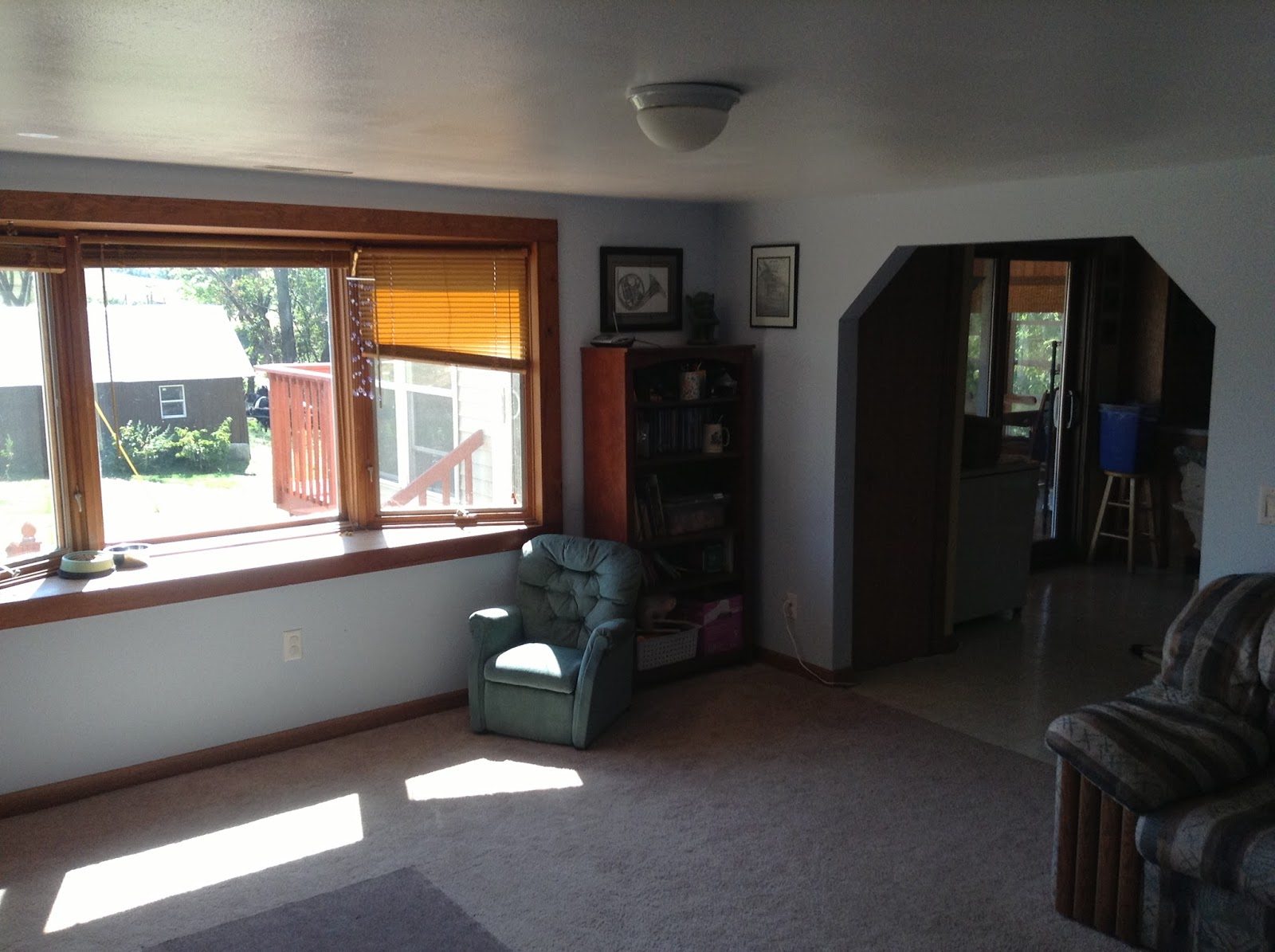
Living room


Sunroom

Friday, August 30, 2013

Tractor Purchase, the Decision Process

I spent an almost immeasurable amount of time figuring out what we were going to do about our primary farm tool, the tractor. I was online reading about specific models and delving into so much information that I had not fully considered before, so I figured I would write some of that process down. I currently own a 1965 Massey Ferguson 135 with an industrial front end loader. It is a nice simple tractor.  I do not intend to move it to the new farm, because it has some limitations that I struggle with.


Current Machine Massey Ferguson 135

Many beginning livestock farmers will say that a loader is essential. I agree that a loader is useful, but I think you really want to have a loader on a four wheel drive or some sort of front end assist machine. In the case of this MF 135, it will get stuck without even blinking. There is too much weight on the front end and not enough on the drive tires. The machine does have fluid filled tires, but that does not seem to make much difference. Maybe if I had wheel mounted side weights, the tractor would work a bit better, but that is a pricy proposition.  For me, I have just used this machine to move bales of hay with the three point spear. For moving bales of hay, the weight of the front end is great. I usually just use the bucket to flip bales of hay on their side before I slip a bale ring around them. I do not feel that this machine fills enough roles on the farm to be worth moving it 60 miles, so I am selling it.

What machine is right for me? I asked myself this question over several weeks.  We know we will be moving out to the farm and there are some machines out there, but there are somethings we do not have on the farm. There is only one machine with a loader, and that is the machine my uncle uses all of the time.  There are no tractors that are four wheel drive or front end assist. Lastly, I had grown accustom to  using a Vermeer mini excavator from time to time, and I know I wanted one.


Work we did on the farm in 2012 with an Excavator

I love excavators and/or backhoes. You would be surprised what all you can do with them. They dig water lines for livestock, they put in tile, they remove stumps. If you saw my last post, then you know I have a very large driveway access to dig. Here is the problem with most tractor excavators, mounting them. Excavators attach to the tractor in two ways. They either attach with the 3 point hitch or they attach to the frame. Excavators are powerful devices that can exert a lot of force on the tractor holding them. The larger the machine (more HP) the larger the category of the 3 point hitch and the more durable those linkages typically are. One higher category machines (2-3) the the backhoe can probably be just fine on the 3 point hitch, but on smaller machines, a 3 point hitch backhoe is more likely to damage parts of the tractor frame.  In either case, a frame mounted excavator is optimal to 3 point hitch mounted excavator because it spreads the forces created by the backhoe through the frame in a more stable fashion. Frame mounted excavators are often removable from the tractor, but there are a variety of attachment methods and some are much easier to remove then others.

There are idle machines on the family farm with high enough horsepower (HP) to make big round bales of hay, optimally 50-60 PTO (Power Take-off) HP for most modern smaller balers, so we did not have to go that high in HP. I can attest that as machine HP goes up machine price generally goes up exponentially (especially with the features I wanted in a machine). Using an idle farm machine would also allow for another machine with a 3 point hitch. This would mean less changing of implements and  reduced need to remove the backhoe from whatever we purchase. The farm has an idle diesel Oliver 1650 tractor that is a possibility use. It will need a new tire, battery, fluid change, and to be primed, but it should be a workable option with a high PTO HP of 66.

Oliver 1650 available on the Family Farm

So we went looking for a machine that had a front end loader (bale spears attachment), four-wheel drive, and an excavator. Our next limitation was price. We wanted to keep annual payments below $2,000. This is a level of debt I felt the business could handle. Machinery loans are generally 5 year loans, unless you are talking a new machine, in which case you have the option of a 7 year loan. Keeping the payment under $2,000 annually and at current rates for machinery of 5% meant I could comfortably borrow $8,500. Initial estimates on our driveway alone put us at $5,000 (a budgeted amount). We felt comfortable adding that into the total as well as the value of our current MF135 of around $3,000. That gave us a striking range of up to $16,500.


The Elusive Kubota L48 Got Away

We considered several different classes of machines from traditional construction backhoes to various tractor options. I moved away from traditional backhoes because they are so large. A traditional backhoe is harder to get taken to a shop when they break down. I am not a very competent mechanic so this is a legitimate concern. Access to dealers was not a big problem being close to Des Moines as almost every brand is represented within 30 to 40 miles. We gravitate toward the Kubota L48, but we just were not able to move fast enough on the ones we found. We missed out on three of them, before the remaining ones were out of our price range, so we went back to the drawing board.

I then stumbled upon a New Holland 2120 with factory loader and backhoe. The loader bucket is removable, but it does use a pin system as opposed to a quick attach system like skid steer or skid loader would use. The backhoe is a Bradco, a very good brand, and is frame mounted, but comes off by removing two pins. The unit also has both front and rear work lights.  We called them up and negotiated things back and forth and got the unit for $13,500 including a front mounted bale spear for the loader.

Rear View New Holland 2120


Front View New Holland 2120


The only real problem at this point was the machine is located in London, Ohio, west of Cleveland. The machine with all of its attachments weighs over 8,000 lbs, and my truck only hauls a max of 6,500 lbs.  Let me just come out and say they working with Brock at Tri-Green Interstate Equipment has been great. They have a family business of working on tractors and trading in them. They were willing to transport the machine to another site outside of Madison, Wisconsin. From there they are going to drop it off at our new farm site on September 10th at no additional cost. They apparently buy tractors out west at auction and haul them east, where they refurbish them and resell them, so hauling the machine to the farm is just a back haul for them. 

Sometimes things just finally click into place. We got the machine working its way to the farm and we are $3,000 under what we might have payed. The New Holland 2120 (same as the Ford 2120) has a lot of good comments associated with it online. Needless to say, I am pleased and look forward to having the machine on site. Sometimes things work out all right. Now, do you know anyone that wants to by a  Massey Ferguson 135?


Tuesday, August 27, 2013

Farm Do-over

We are very near the point of beginning a massive transition in our lives and on the farm. We are moving the farm 60 miles west to just south of De Soto, IA in northern Madison County. We will be buying a small piece of the family farm, precisely 20 acres of land out of a complex of over 800 acres. My family has farmed in that area for four generations, but there is only one member of my direct family line still farming out there. Our objective is to get ourselves set-up at the new site  and see where things take us. I am trying to think of this as a farming do-over. A chance to do what we wanted to 6 years ago when we left college, but family politics and our lack of experience farming prevented us from pursuing that plan.


A Rough Panaramic View of the New Farm

I have no expectation that this will be an easy process, but I think it is right for our family and our business in the future. This new location will provide us with the potential access to farm assets including land that the family owns that is not being utilized or is being under utilized. This move also allows us potential access to farm equipment, even if a good amount of it has not been used in many years. It allows us the amenities of West Des Moines in less then 30 minutes of driving. This includes more employment options for Janice and the pre-school options we wanted for Hazel. Lastly, it allows much better access to more customers for our business. Pella has been a very big part of our business, but it took us along time to get going and I am concerned that we are reaching the limits of what we might expect from that market. We do still intend to bring product to Pella to continue to serve our customers there because we value them not only as customers, but as friends.

There is an added layer of complexity (you might have guessed it from the photo), we will be moving to a blank site. The farm complex has multiple houses, many of them are in various states of disrepair. None of the old houses are located in a place that fit our parameters and all of them would take significant money and time to make livable. Our wants for a potential site were as follows: it had to have ready access to rural water, it had to have access to rural broadband internet, it needed to be something that was not being used or was under utilized, and we preferred it to be in the Adel-Desoto-Minburn School District (ADM). There were only two places on the farm that fit these objectives. We were lucky enough to negotiate the better of the two options.


Aerial of New Site

We close on the land in early September. We are currently planning on locating our future house and buildings imbedded in the southeast portion of the black Locust grove by the road. This will mean much time behind the chain saw. Luckily Black locust makes excellent fence posts if allowed to dry first and shed its bark. We will also need to build a new access because the current site access is blind and quite dangerous given the traffic on the road. This will be no small feat as it is very steep hill we will have to tear into and grade out. We have purchased a different tractor to aid us in this process, that I will touch on in more detail soon.


Location of Future Site Access

Lastly, we have already signed a contract to have a farm building constructed on site by Cleary Construction in De Soto, IA. We got a good deal on a basic structure that will be a 30x50 foot building, with a 10 foot high access door. The building will then be extended an additional 12 feet and ending with an open lean-to. The intent of the building is house machinery in the main bay and allow us to block the lean-to part of the building off to allow shelter for livestock. With the cost of building a building it seamed better to us to build quite a bit bigger then we immediately need and just grow into it.


Representation of what the Building Minus the Lean-to Extension on the Right Side


If we can get all of that done and begin to lay out fencing and digging in water lines by winter, that would be great. There are many more details that we are chipping on. This is a big shift for us and we are trying to hit it as hard as we can right now.

I must apologize for not being very communicative with our customers this year, be it email or blog post. We have had a lot on our plate. Having a baby at home and a three year old has been very draining. Janice has been working on her MBA at night and one many weekends. Preschool started on Monday, and I am feeling invigorated with the freedom this affords me. I do intend to blog more regularly as we have quite a bit to talk about moving forward. I want to talk about lessens I leaned on this farm, things I don't like, thinks I like, things we are going to replicate on the new farm, and things I will try very hard to avoid. To that end, I am hoping to blog at least weekly if not biweekly from here to winter, so stay tuned as we flip our world upside down.


First Day of Preschool, Yay

Sunday, July 14, 2013

Things are a Brewing, mean while we are Carrying On

It has again been too long since my last blog post. We have been working on making a massive change in our farming operation, that being said it is not a done deal and I would rather not let the cat out of the bag until there is more clarity about this change. I hope to be able to share this change with you in the next week.

Our egg production is down a bit. We had a hard spring with a persistent fox that I struggled to deal with. He would strike in the middle of the day and use the cover of pasture, road, ditch, or even the draw behind the house as cover on the approach. We might have lost as many as 20 birds to the fox, but I finally got the darn thing with the last three bullets I had in my 22. I have found it hard to locate .22 mm rounds. All of the local shops are out. I presume that is associated with the threat of gun control legislation this spring. This does not make a great deal of sense to me, because there was no real threat about restrictions to the common .22 round, but then ardent gun advocates and I don't always see eye to eye on things.

For the time being I will try to share some of the more mundane things going on. The turkeys arrived back in late April. I got 82 in the mail, and I have something like 65 (enough of them die that I tend to lose count) that made it into early adulthood. That was higher mortality then I was going for, but I will have to live with it. I tried to run them earlier to avoid the warm weather of June and July we had last year. This year was quite cold for most of the spring. Many of the crops did not get planted in surrounding areas because of the cool wet spring, and even then some of them got flooded out. This year has been the diametric opposite of last year. I can honestly say that right now is the first time this growing season where it is getting pretty dry out. We are taking orders for Turkeys so let us know if you are looking for a Thanksgiving bird. Our birds should be ready for October delivery, and might be ready for September delivery.

We did not raise chickens this spring. It turns out with the cold spring that this was not a bad idea. Fall chickens should be arriving within the next week and I think we will have birds by September deliveries.

Cattle are doing well. We did just drop a beef off at the locker so beef will be ready for distribution by late July or early August. I love having grass-fed beef in stock and I eagerly look forward to having some available for customers again.


Cattle on Spring Pasture

Around the farm, we have been chipping on projects. We fixed the shop front, which had been damaged in a wind storm several years ago, we did finish putting the eave spouts on the chicken house, and we have been working on cleaning out buildings, and getting our scrap piles cleaned up. Jim, our super helper from Pella, has been a big help through this process.

I did take a weekend to pick berries around the farm. With the unusually wet weather this spring, the berry crop was amazing this year. I picked 15 pounds of berries in one morning with our daughter helping me. Our haul included mulberries, sour cherries, and Juneberries. In the photo below, I left our the cherries, but you can see the Juneberries on the left and the mulberries on the right. We have a variety of mulberries on this farm. We have the white and the dark purple ones, as well as their hybrid light purple to pink ones.


Juneberry and Mulberries fresh from Picking

I would like to take the opportunity to put a plug in for the Juneberry (Serviceberry or Shadush). It is an underrated small tree. Janice did not understand my enthusiasm when I planted them four years ago, but she is been eating her words this year. They are a lot like a blueberry grown on a carefree native small tree verses a temperamental little bush. They have been good in oatmeal, in cobblers, or just eaten straight. 

Juneberry Tree

JuneBerry Close-up, those are perfectly ripe.

Our little boy has been crawling since the middle of May, but he has never really felt like crawling was enough for him. After all he does have a toddler sister to keep up with. So he has been trying to pull himself up and move along surfaces with the occasional few seconds of free standing.  He remains as calm and as mellow as ever. Usually the only time he really protests is when he sister is interrupting his standing by dragging him around or when he tumbles hard.


Our Little Guy working his way along the Sofa

Our daughter has been, well, a toddler. She got a haircut about a month ago, which can be seen in the photos below. We have been working on toilet training. It is still a work in progress. She has a massive bladder, like her dad, and so we don't get very many chances to practice in a given day. She is getting better at being outside, but her fear of chickens, born about by a bad encounter with a rooster, still makes it hard to work with her outside.

Painting Time
Perhaps a little over-equipped to go Check Cows

Wednesday, May 22, 2013

2013 Farm Plans

I have had an almost three month hiatus from blogging and a far number of things have gone on during that time, but I will only touch on a few of them.  We had lambs in mid March to early April, 22 of them were born and 18 of them have made it. We stated off poorly, by having a good ewe get an infection in her uterus and die, and we then lost one of her lambs. We also had a ewe give birth to quintuplets, which we were able to save two of them.  Other then the bad start, this lambing season has been much better then past seasons. The sheep herd has been out on pasture for three weeks now and doing quite well.


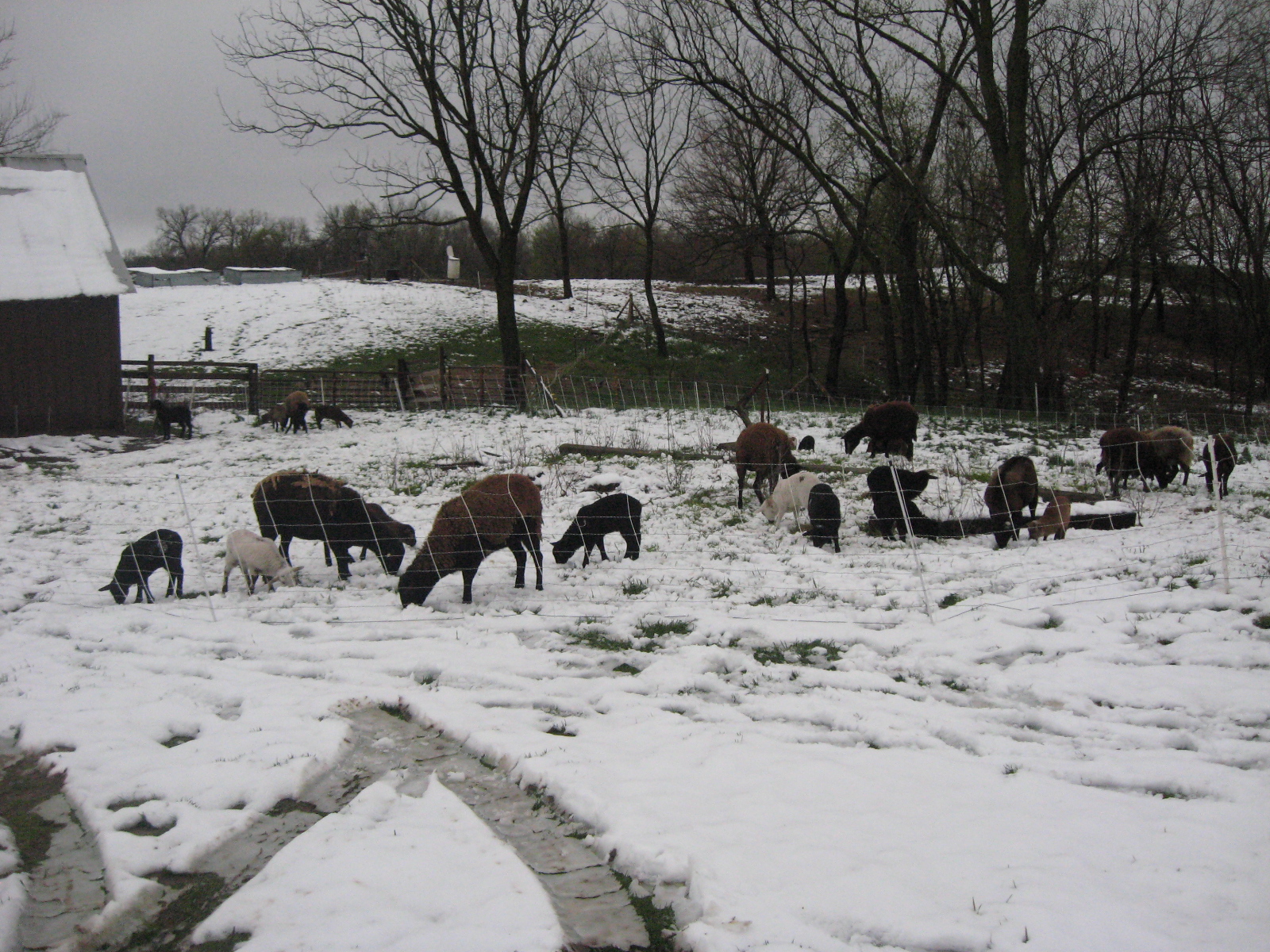
Sheep Herd out on Pasture in Early May After a Very Late Snow Storm

This whole spring was the opposite of last year. It was cool for a very long time and it took a long time to get get the grass growing tall and fast enough to start grazing it. We had to buy quite a bit of hay to cover another three weeks of grass.  We also had another calf born during the last three months from a first calf heifer. All told, our herd now comes to 18 head. It is our hope to have larger supplies of beef soon, but our lead time on beef is around 27 months, so we do not have much supply planned for 2013, but 2014 is looking much more promising.


New Spring Calf Waiting for Spring Grazing to Get Started

The biggest news I wanted to share with customers is that the 2013 order form is live on the website. We are still planning on doing a customer newsletter, but it has not happened yet. Since we now have two kids to factor into things, there will be some changes this year. We will be making fewer deliveries to Ames and Des Moines in 2013. We looked into the cost of doing deliveries versus the return on that time & fuel this winter for all of our sites. Ames & Des Moines  had much higher costs per sale then Pella and represented a smaller percentage of sales then Pella. Pella deliveries will be monthly, while Ames & Des Moines scheduled deliveries will be June, August, October, & November. Hopefully, this will encourage people to simply order a bit more per delivery to cover the longer gap between deliveries. Customers in Ames & Des Moines can also order our products on the Iowa Food Cooperative, which deliveries to multiple locatins to in the Des Moines area and to Ames every two to three weeks.

Two children has also spurred some production changes as well. We will be raising many fewer meat chickens this year. Right now we still have inventory from last year. When that runs out, we will not have any more chickens until our October deliveries. Broiler chickens are quite a lot of work to raise (time, energy, materials handling) and the return on investment is not great. It is very easy to loose money on them if they are even a bit small. Cool wet springs are not always the best time to raise them, and we typically see better development of broilers in the fall. We will be starting turkeys earlier this year. If you want turkeys in October, they should be ready by October delivery time. When we built out new brooder building, we likely over insulated it. My objective is to shift turkey production earlier so the turkeys are moving out of the brooder as the hottest part of summer is beginning. We have also changed out turkey supplier this year in hopes to avoid some of the problems of the past three years. Right now all we have in the brooder is 50 layers to cycle into our flock later in the year.


Black Australorp Layer Chicks in the Brooder

We are working on a few larger projects this year. Progress on the chicken building continues slowly as I am hoping to finish work on the trim, nesting boxes, and eave spouts this month. We have some large fencing projects to tackle this year. A neighbor cleared out numerous trees last year in our mutual fence lines, but he left the ground rough and with no fence. This all has to be corrected including dirt work and new fencing. There will also be a lot of additional tree work to round out the project. With two kids and how far away from the house this work will have to take place, it will take much of the year to complete.

Look forward to quite a bit of lamb in October. There will be a limited supply of beef in August, and possibly more in October. Turkeys will be available again starting in October. We will see how things go this year. Right now, I am taking it a day at a time. I am sure there will be significant challenges juggling a farm, a 3 year old and a baby, so stay tuned.

The Marquardt Kids with Very Serious Expressions

Thursday, February 28, 2013

February Limbo

February has come and gone and there is no massive activity to report. A couple of little highlights do rise to the surface and a worth sharing.

In early February, just after some of our coldest weather of the year, we had a calf from a first calf heifer. The little gal is all back and petty personable. Mom & calf have been inside almost the entire month so they pretty much ready to move outside.

First Calf Heifer with her First Calf

I have been taking stock of this year and what tasks we might get to this spring as well as identifying what resources we might need to finish out the winter.  I surveyed our hay the other day and we  are eating a bit more hay then I rationed. I believe I have a little over 30 days of hay. That means, we will run out of hay in early April, or about two weeks (4-5 bales of hay) ahead of where I wanted to be. Depending on how the spring plays out, we may have to buy a few bales 

We are staring to pull out our planning charts so we can work on our production timing. March is when we try to send out our customer newsletter to communicate our plans for 2013 and make our customers aware of opportunities to get special product or limited supplies of things. I looks like much of 2013 will be learning how to farm with two children. I still have the goal of adding to our exterior fence on the north-side of our property and on the east & west sides of the 10 acres I am currently renting. We will also try to put the finishing touches on the chicken building & do some dirt work. Dirt work would include tiling in front of our chicken building, adding a hydrant for the chicken building, and possibly extending our water system on the north side of the property a bit.  

In the next week, I need to move the new cow & calf outside, and move the ewes inside. We are not to far to the start of the lambing season. I hope to get 12-16 healthy and robust lambs this year. I also need to pull the bull out of the herd to avoid late fall/early winter calving next year. 

Not a lot of progress has really happened since January. I did manage to get on top of the poultry building and begin caping the top edge of the roof. I finished the task, except for the last 3 feet of a 39 foot roof. It helps if you buy enough raw material to finish the desired task. Sigh. 

Farm building seeing some trim progress

Our entire household has spent most of the month of February sick. We have all had head colds that developed into bronchial infections. We are almost all on medication now to try to break the cycle of starting to get get beater only to be just as sick as ever a few days later. 

Our Son is doing pretty good. We just weighed him today and he has cracked 15 pounds already. He is into cooing and making a vaiety of noises, as well has being assisted in standing. He did manage to roll over for the first time a about a week ago, that does not mean he is a fan of tummy time though.  

A Boy & His Mother

I tried an interesting experiment with our daughter early in the month. She is scared/dislikes snow. So I filled up a tub of snow and placed it in the kitchen sink so she could play with it, without the movement limitations of her winter clothing. She really enjoyed it and has generally been better around snow outside ever since. 

Playing with a Tub Full of Snow

Well that is it from the farm for now. Stay tuned next month as I have to be much more of a farmer again.